By Ilane Tall · Updated October 11, 2026 · Research-based.
Reader-supported: we may earn a commission when you buy through the links on this page, at no additional cost to you. It never changes which product we recommend. Prices quoted below were correct at the time of writing and move often.
Quick answer
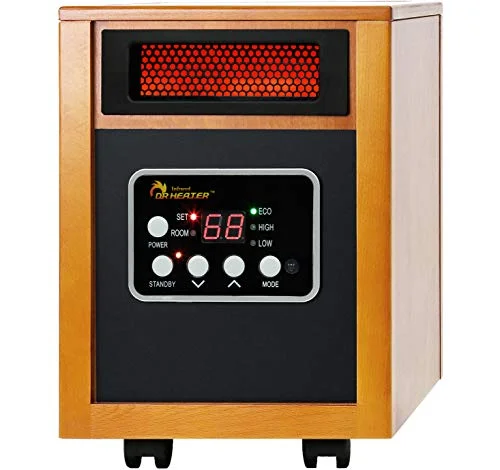
Every heater on this page is built around the same roughly 1,500-watt ceiling, so in a large room the only real variable is how that fixed heat reaches you. The Dr Infrared Heater DR-968 ($104.99) is our pick if you're furnishing one large room and want to be done shopping: it pairs an infrared quartz element with a PTC ceramic element in one cabinet, warming the air and the people sitting in it.
If the room is genuinely large — open-plan, two seating zones — the honest answer is often two heaters, not one bigger one. Add the DREO 25-Inch ($79.96), a tower built to push air across the far end, rather than replacing the first heater with something larger. The duraflame Freestanding Stove ($259.99) is rated to 1,000 square feet, and that number deserves a second look before you buy on it alone.
Why every heater here draws the same 1,500 watts
Start with the number that doesn't change, because it explains almost everything else on this page. A standard US household circuit runs 120 volts at 15 amps, about 1,800 watts in theory. In practice, portable electric heaters sold for that outlet are built to roughly 1,500 watts, leaving headroom under UL safety testing and the rule that a device shouldn't run at more than 80% of a circuit's rated capacity for a sustained period. That figure isn't a marketing choice any one brand makes; it's close to the practical ceiling of what a single US wall outlet can deliver to a plug-in appliance, continuously, without an electrician getting involved.
The Dr Infrared Heater DR-968 states this outright: 1,500 watts is in the product's own title, and at full output it draws roughly 12.5 amps — close enough to a 15-amp circuit's limit that it wants an outlet of its own rather than one shared with a microwave or a hair dryer.
Neither the DREO 25-Inch nor the duraflame freestanding stove states a wattage figure in the listing data we have, and we're not going to invent one. What we can say honestly is that both are indoor, plug-in heaters built for the same US wall outlets as the DR-968, and nothing in either listing suggests an exception to how this category is built. Treat 1,500 watts as the safe working assumption for any plug-in space heater unless its own listing states otherwise — and treat a listing that omits wattage as a gap in the data, not a claim either way.
What this means practically: the $79.96 DREO tower and the $259.99 duraflame stove are not competing on how much heat they can put out. They're competing on cabinet size, materials, a flame-effect display, remote control and, as the next two sections cover, how that fixed wattage actually reaches the room.
The duraflame stove's own title states it: "for 1,000 Sq. Ft. Room." That's a specific, confident number, and it's worth asking what it's actually measuring before it decides a purchase.
Square-footage ratings on space heaters aren't independently audited the way a refrigerator's energy label is. They come from the manufacturer, measured under conditions chosen to be favorable: a closed, single-story room with a standard ceiling height, reasonable insulation, no major draft sources, and no competing heat loss through large windows or an open stairwell. A 1,000-square-foot rating describes that room, not necessarily yours.
Real rooms deviate from that test case in ways that matter. A vaulted ceiling adds volume the rating doesn't account for, since a taller room has more air above head height to warm before floor level feels different. An open floor plan connecting a living room to a kitchen and a hallway isn't a sealed 1,000 square feet — it's 1,000 square feet with extra doorways bleeding heat into rooms nobody is trying to warm. A finished basement fights cold coming up through the floor, which a manufacturer's test room typically does not. None of this makes the figure false. It makes it a best-case ceiling, not a guarantee — worth knowing before the box arrives rather than after.
The DREO 25-Inch takes a different approach: it's marketed for "Large Room" use, but the listing data we have doesn't include a specific square-footage number. That's an honest gap rather than an oversight — we'd rather say the figure isn't available than guess one to fill the page. If a specific square-footage commitment matters to you, check the current listing directly; we're not going to state a number we can't verify.
The practical approach: read any square-footage rating as the best case, not the expected case, then mentally discount it based on ceiling height, how open the floor plan is, which floor of the house you're on, and how many windows and doors are between the heater and the far corner of the room.
Moving air versus warming objects: the choice that decides a big room
Put the wattage question aside and there are really only two physical strategies a space heater uses, plus one hybrid of the two. A convection heater warms the air around its heating element and relies on a fan, or on warm air rising and circulating, to move that heat through the room. A radiant or infrared heater skips the air almost entirely and warms whatever sits directly in its line of sight — a person, a sofa, a rug — the way sunlight warms your skin before it warms the air around you. In a large room, which strategy a heater uses matters more than almost any other spec, because it decides whether the heat fills the room's volume or just one corner of it.
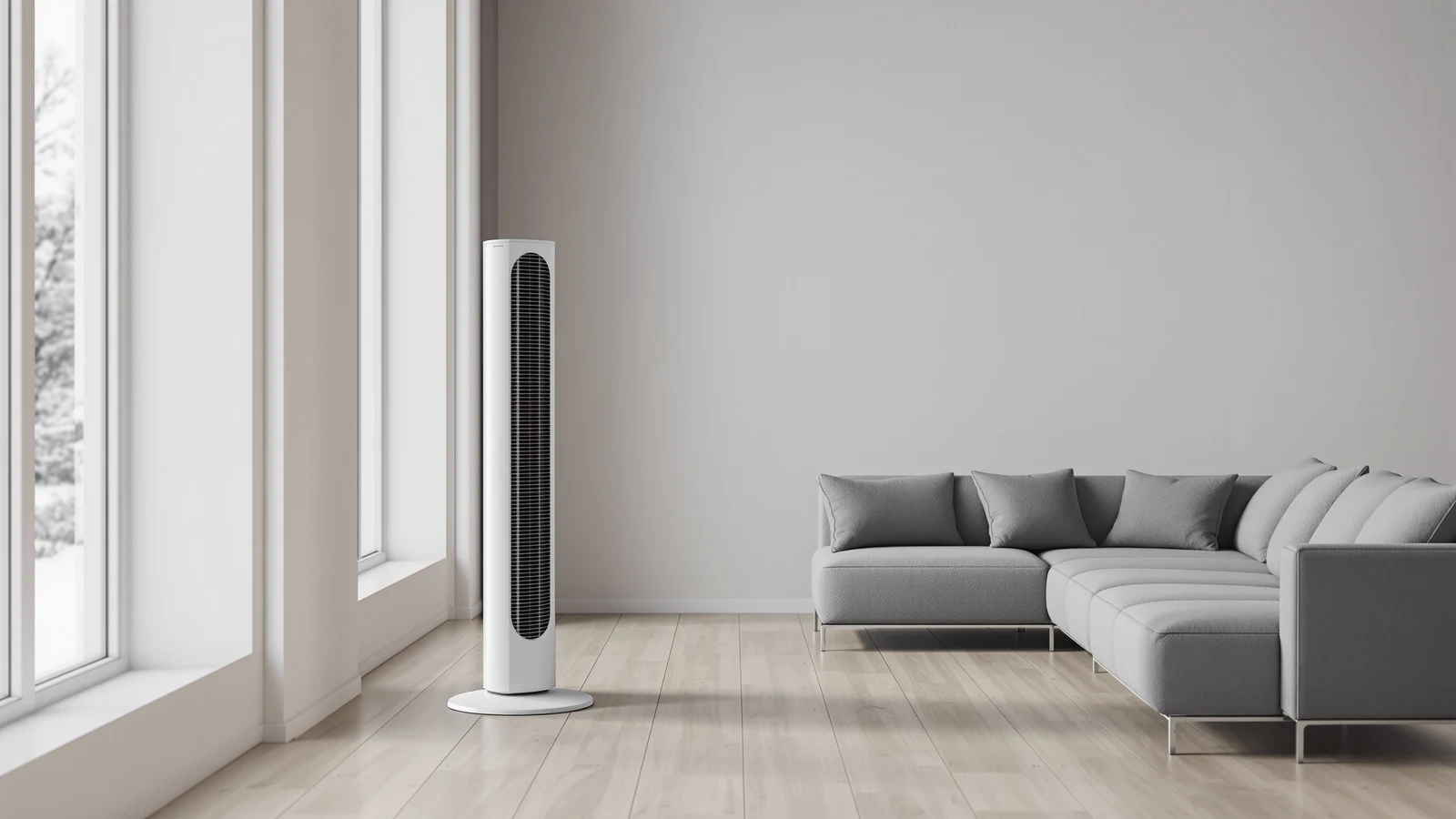
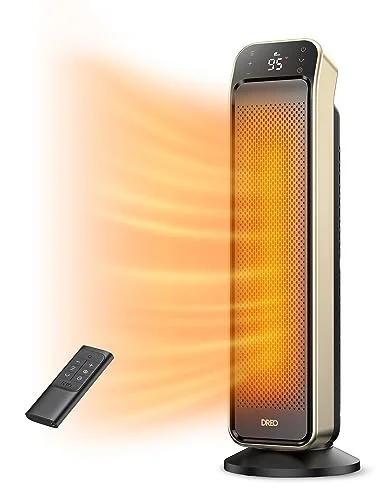
The DREO 25-Inch is built as a tall, slim tower, the format this category uses specifically to move air: a vertical fan path that pulls air in low and pushes it out across the room rather than radiating from a fixed point. That's the mechanism behind any "large room" tower heater's pitch — circulate the same 1,500 watts over more floor space, rather than concentrating it. The listing's product imagery shows a digital display and an included remote, consistent with a unit meant to be set and left running.
The Dr Infrared DR-968 is the hybrid: an infrared quartz tube and a PTC ceramic element sharing one cabinet, so it warms the air moving through the unit and the people and furniture in front of it at the same time. That combination is why it suits a room you actually sit in for hours, rather than a hallway you only pass through — it's doing two jobs other heaters on this page do separately.
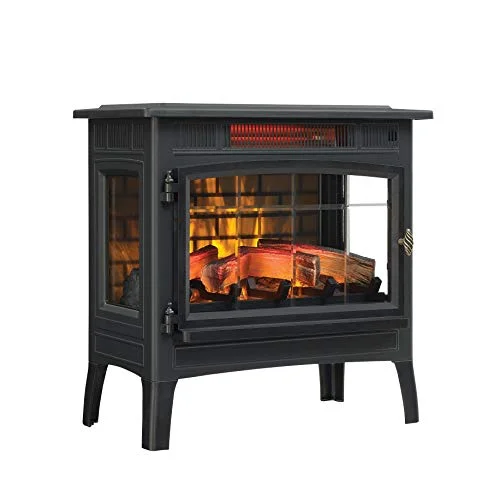
The duraflame freestanding stove is closer to a pure radiant heater, built around an infrared element inside a stove-style cabinet with a 3D flame effect behind glass. It's honest about what it's for: warming the people in front of it and making the room look like it has a working fireplace, not filling an entire open-plan floor with uniform warm air. The 1,000-square-foot rating on the box describes the room it could theoretically heat under favorable conditions; owning it feels closer to a very good seating-area heater with a convincing flame effect.
None of this makes one mechanism better than another in the abstract. It makes them suited to different large rooms: a tower for a room you want evenly warm end to end, a hybrid for a single room you live in, and a radiant stove for a seating zone you want warm and want to look at.
The picks
Three heaters, three different answers to the same large-room problem — not a ranked list, since "best" depends on whether you're warming one room, one zone within a bigger room, or deciding whether a second heater belongs in the cart at all.
01Best for one large room
Dr Infrared Heater DR-968
The hybrid pick: warms the air and the people in it
Infrared quartz + PTC·1,500 Watt·Cherry, Original·12.5 amps
Two heating elements in one cabinet — an infrared quartz tube and a PTC ceramic element — so it warms the objects and people in front of it as well as the air moving through the room, rather than relying on a fan alone. That's why it suits a large room you're actually furnishing rather than one you walk through: a pure convection tower fills air volume faster, but the DR-968 does double duty. It's a cabinet rather than a slim tower, so it asks for real floor space, and at a stated 1,500 watts and roughly 12.5 amps it wants an outlet of its own.
The pick if you want one heater to do the whole job in one large room and you're not trying to cover a second zone.
02Best for a second zone
DREO 25 Inch Electric Space Heater
The tower pick: built to push air across the far end of the room
25-inch tower·Thermostat·Large, size variant·Remote included
A 25-inch tower marketed by DREO for large-room use, built with a thermostat so it cycles to hold a temperature rather than running flat out. The listing's product photos show a digital display and an included remote, matching a unit meant to be set once and left running at the opposite end of a room from your primary heater. We don't have a stated square-footage or decibel figure for this listing, so we're not going to claim one — check the current listing if either number matters to you. At $79.96, the honest use is as the second heater in a two-heater setup, not a replacement for a hybrid or radiant unit in the zone you actually sit in.
Buy this to cover the part of a large room your first heater can't reach, not to replace it.
03Best for a seating zone you look at
duraflame Freestanding Electric Fireplace Stove
The radiant pick, rated to 1,000 sq ft — read that rating first
Infrared·3D flame effect·Rated for 1,000 Sq. Ft.·13.07"D x 24"W x 23.4"H
A freestanding stove cabinet with a 3D flame effect behind glass, built around an infrared heating element and rated by duraflame for a 1,000-square-foot room. As covered above, treat that number as a best-case ceiling, not a promise about your specific room — a vaulted ceiling or an open floor plan changes the real-world outcome more than the rating lets on. What it's genuinely good at is warming a seating zone while looking like a real stove doing it, at 13.07 inches deep by 24 inches wide by 23.4 inches tall — worth checking against your floor space, since it's the largest footprint of the three picks here.
The pick if the room needs to look warm as much as it needs to be warm — and you're honest about the rating being a ceiling, not a guarantee.
When one heater is the wrong answer and two is the right one
Here's the piece of the 1,500-watt ceiling most buyers don't think through until the heater is already running: there is no bigger plug-in heater to buy. Unlike a furnace, where a bigger room genuinely gets a bigger unit, a portable electric heater sold for a standard US outlet tops out at roughly 1,500 watts almost without exception, for the circuit reasons covered earlier. Once you own a 1,500-watt heater, whichever one it is, you own the ceiling. "Buy the biggest one" isn't a real upgrade path here the way it is in most categories.
A single heater also has an effective range, shorter than the square-footage rating on the box suggests. An infrared heater is directional by design — the far side of a sofa, or anything outside its line of sight, stays close to room temperature no matter how long it runs. A convection tower fills more of the room's air volume, but still warms the air nearest it first, so the half of a large room farthest from the unit is the last part to feel any different. Put the heater at one end of a genuinely large room, with seating at the other, and a single unit frequently cannot do justice to both.
One heater is enough when
The room is a single enclosed space, the seating is within roughly 10–12 feet of the unit, and you mainly need one zone — a bedroom, a home office, or a living room you're not trying to heat corner to corner.
Two heaters beat one bigger heater when
The floor plan is open, there are two seating areas, or the room is long enough that one heater's output genuinely can't reach both ends — because a bigger single unit isn't an option at this wattage ceiling.
This is where pairing two heaters, rather than searching for one mythical "large room" unit that doesn't exist at this price or wattage, is the more honest answer. Put a hybrid or radiant unit like the DR-968 where people actually sit, and a convection tower like the DREO 25-Inch at the far end or near a doorway, to keep air moving rather than letting it pool cold near an entrance. Combined, that's 3,000 watts genuinely distributed across a room the way one 1,500-watt unit, however it's marketed, cannot manage alone.
The catch runs the same wattage math the other direction. Two 1,500-watt heaters draw roughly 25 amps combined — well past what a single 15-amp residential circuit is rated to carry. Running both from outlets on the same circuit, or the same power strip, is how breakers trip. Before committing to a two-heater setup, check which outlets in your home actually share a breaker; your electrical panel is the authority here, not a guess based on which walls the outlets are on.
How we picked
We started from our own database of space heaters listed for sale in the US and looked specifically for products marketed around large-room use, rather than pulling three near-identical tower fans that differ mainly in color. The three products here represent three different heat-delivery mechanisms — convection tower, infrared-plus-ceramic hybrid, and radiant stove — on purpose, since the mechanism matters more than any other spec once a room gets genuinely large.
How we compared
We compared the three heaters on their published titles, available specifications and current Amazon prices. For two of the three — the DREO 25-Inch and the duraflame stove — the listing data we worked from does not include a stated wattage or noise figure, and we say so plainly above rather than estimate one to fill a gap. Where we cite a specific number, such as the DR-968's 1,500 watts and 12.5 amps, or the duraflame's 1,000-square-foot rating and dimensions, it comes directly from the product's own listing.
We do not run a testing lab. We do not own these three heaters and have not run them in a room ourselves, so you will not find an invented decibel reading or a score out of ten anywhere on this page. We also don't show star ratings, review counts or paraphrased owner sentiment, because we don't have manufacturer-published figures for these specific listings — a limitation of the data available to us, not a judgment on the heaters themselves.
Frequently asked questions
Does wattage even matter when choosing a heater for a big room?
Less than you'd think. Virtually every plug-in electric space heater sold for a standard US outlet runs at roughly 1,500 watts, the practical ceiling of a 15-amp residential circuit. Dr Infrared states this directly for the DR-968; it's the reasonable assumption for any similar indoor plug-in heater unless its listing says otherwise. The real differences come from how that fixed wattage is delivered — moving air, aiming infrared, or both — not from one heater producing more heat than another.
What does a manufacturer's square-footage rating actually measure?
It's typically measured in a closed, single-story test room with standard ceiling height, good insulation and no major drafts — favorable conditions, not conditions guaranteed to match your home. A vaulted ceiling, an open floor plan or extra doorways will pull real-world performance below the rated figure. Treat any square-footage claim, including the duraflame's 1,000-square-foot rating here, as a best-case ceiling rather than a promise.
Should I buy one large heater or two smaller ones for a big room?
Often two, because "one bigger heater" isn't really available at this wattage ceiling — nearly every plug-in unit tops out around 1,500 watts regardless of price. If the room is open-plan or has two seating areas, pairing a radiant or hybrid heater like the DR-968 where people sit with a convection tower like the DREO 25-Inch at the far end covers more of the room than one unit alone, as long as both run on separate circuits.
Will running two heaters at once trip a breaker?
It can, if both are plugged into outlets on the same circuit. Two 1,500-watt heaters draw roughly 25 amps combined, well past a standard 15-amp circuit's rating. Before setting up a two-heater arrangement, check which outlets actually share a breaker with your home's panel, rather than assuming separate walls mean separate circuits.
Written by Ilane Tall. Research-based comparisons of published specifications, current prices and public product data — we do not physically test these units and we do not publish invented scores.